

There’s a specific kind of exhaustion that comes from being constantly accessible.
Not available sometimes.
Accessible all the time.
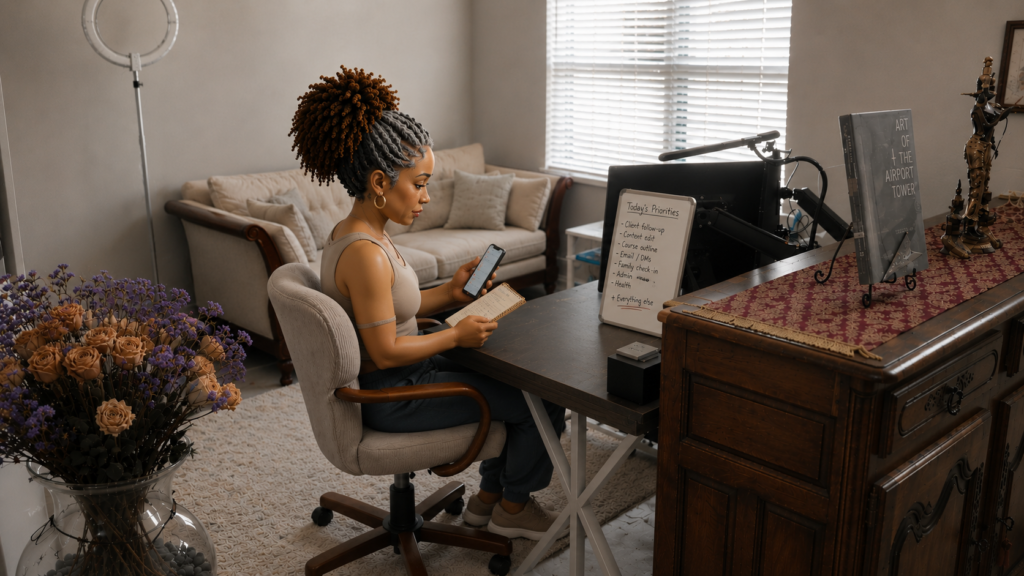
I work from home, and my desk sits in an open area of the house. No door. No walls. No real separation between “working” and “available.”
Don’t get me wrong, I like having my office there. I get sunlight during the day. I can see outside. I don’t feel boxed in or isolated from the rest of the house all day long.
But because the space is open, over time what has naturally happened is: if they can see me, they can ask me something.
Makes sense and I’m not scolding or blaming anyone. It’s just that when your attention gets pulled in multiple directions all day long, day after day, your brain starts adapting to that differently.
Eventually your brain stops experiencing interruptions as interruptions and starts treating them as incoming workload.
The Other 14 Tabs
The other day I was at my desk working when my phone rang. It was DH.
While I was talking to him, my mom walked over because she needed help with something involving a doctor’s office and insurance.
And before anybody even finished speaking, my brain had already started calculating.
I’ll have to pause working.
I’ll have to get off the phone.
I need to start taking notes immediately.
Because I’m going to have to remember follow-ups later.
Something on my schedule is probably going to shift.
I need to watch my tone so momma doesn’t feel bad for needing help.
That all happened in seconds.
To most people, it’s just a question, but my brain immediately opens 14 other tabs.
This is why DH doesn’t call me during the day as often as he used to. He started realizing I was almost always in the middle of something. Same for my sissy. And momma tries to limit interruptions too.
I feel bad about it because I know none of them are trying to overwhelm me.
If It’s Not Written Down, It Doesn’t Exist
This is also why I’ve become obsessive about writing things down.
Because the second multiple tabs open in my brain all at once, I already know something is at risk of falling through the cracks unless I capture it immediately.
There are only so many moving pieces your brain can hold before something starts slipping. That’s why I say this all the time now:
If it’s not written down, it doesn’t exist.
People think that’s me being organized or extra LOL. It’s not… just straight up survival.
Because when you’re tracking appointments, reminders, bills, household stuff, errands, birthdays, follow-ups, groceries, maintenance, scheduling, rescheduling, and everybody else’s moving parts at the same time, your brain starts functioning like overloaded browser tabs.
Something is always running in the background.
And eventually you start saying things like:
“Dang it, I forgot.”
But most of the time, the problem isn’t that you forgot.
It’s that the thing never made it onto the list in the first place.
You’re Not Forgetful. You’re Overloaded.
Because another thing felt more urgent.
Because somebody asked something while you were already doing three other things.
Because your brain was already trying to track too many moving pieces at once.
That’s why I keep telling people: “If you want me to remember something, text it to me.”
I’m not trying to be a pain in the ass. It’s just that there are too many moving pieces competing for attention at the exact same time.
And I think a lot of women are walking around calling themselves forgetful when what they really are is overloaded.
Questions aren’t always: real quick, simple, or one-and-done.
Every question requires:
- attention
- context switching
- tracking
- emotional regulation
- remembering
- follow-through
And when enough of those stack up day after day after day, your nervous system never fully settles.
This is why I think a lot of people don’t even realize they’re functioning as caregivers. Because caregiving isn’t always dramatic.
Sometimes it just looks like being the person who tracks everything. The person who keeps mental tabs open for everybody else in the house.
Caregiving is also:
- making sure there’s another bar of soap in the shower
- bringing food home to eliminate the neverending dinner decision
- offering a cup of tea before they realize they need it
- remembering birthdays and appointments and paperwork and refills
- quietly carrying the mental load of an entire household
Individually, none of it sounds like a big deal.
But when enough of those little things stack up, eventually that’s your whole life.
Why Rest Doesn’t Always Work
And I think this is why so many of us stay tired no matter how much sleep we get.
Because it’s not physical exhaustion in the normal sense. It’s the exhaustion that comes from your brain never fully closing the tabs.
You can sleep.
You can take a break.
You can stop for a weekend.
But the second you start engaging with life again, it all floods right back in.
Because the exhaustion isn’t coming from movement.
It’s coming from management.
From tracking. From constantly splitting your attention between your own needs and everybody else’s.
And you know what? This might sound awful but sometimes it feels like the only cure would be to stop caring completely.
But that’s not what we really want.
We love deeply.
We care deeply.
We’re just depleted from carrying so much of the responsibility for keeping life moving.
_______
This Connects To…
→ Running on Empty
→ Running on Nothing